“The development of physical culture and sport in our country is an important part of the communist upbringing of the people. The successes of Soviet athletes on the international arena clearly demonstrate the vitality and strength of socialist society and serve the cause of strengthening peace and friendship among peoples.” – Unknown Speech on Soviet Sports Propaganda
The Role of Sports in Soviet Propaganda
At the height of the Cold War, and on global stages like the Olympic Games, sport became a powerful tool for projecting the strength of the Soviet system. International victories were framed as proof of socialism’s superiority, while mass participation in sport was encouraged to cultivate a population that was healthy, disciplined, and united.
The underlying logic was simple: strong athletes create strong citizens, strong citizens build a strong state, and a strong state validates the success of socialism. Across the USSR, this message was embedded into everyday life through visual culture. Monumental mosaics celebrating sport, teamwork, and collective effort appeared on public buildings, transforming ideology into something people encountered daily.
Although a softer approach was adopted for the 1980 Moscow Olympics, including the use of Misha the bear as a friendly mascot, the aim was to present a more approachable image to the wider international audiences.
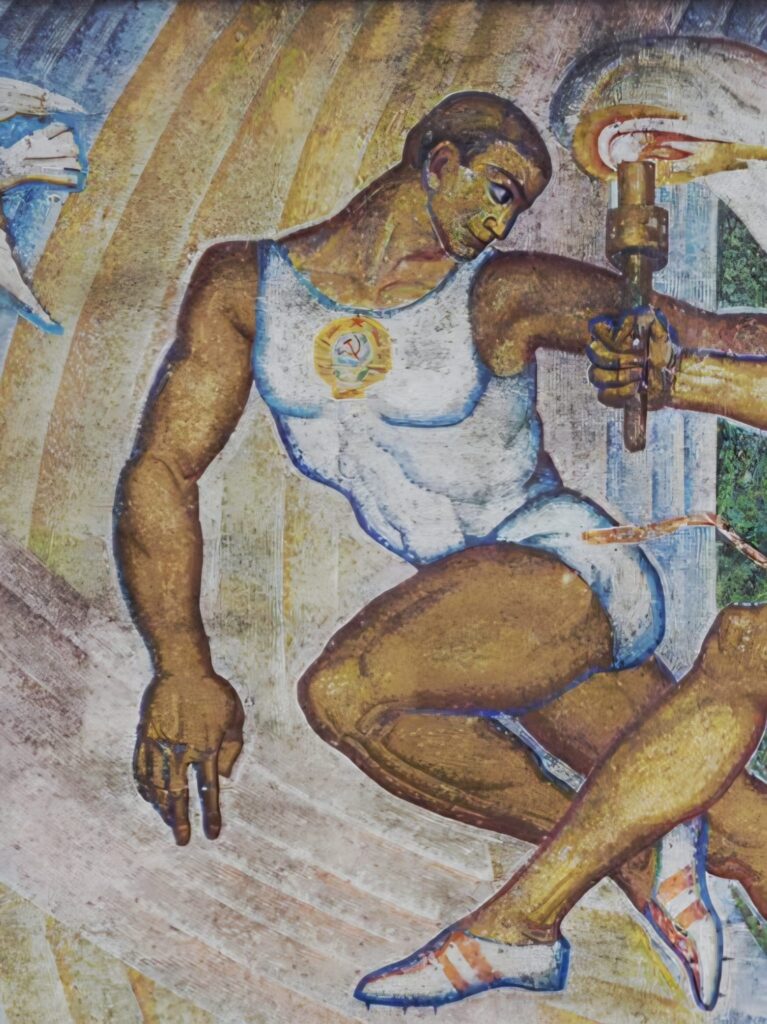
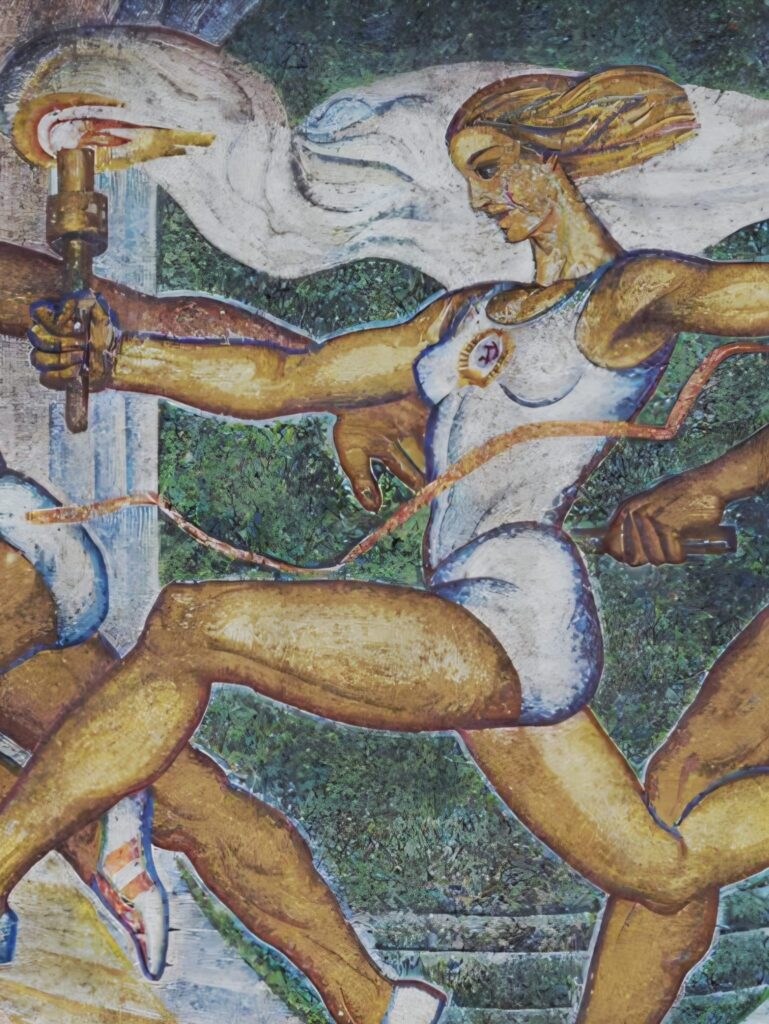
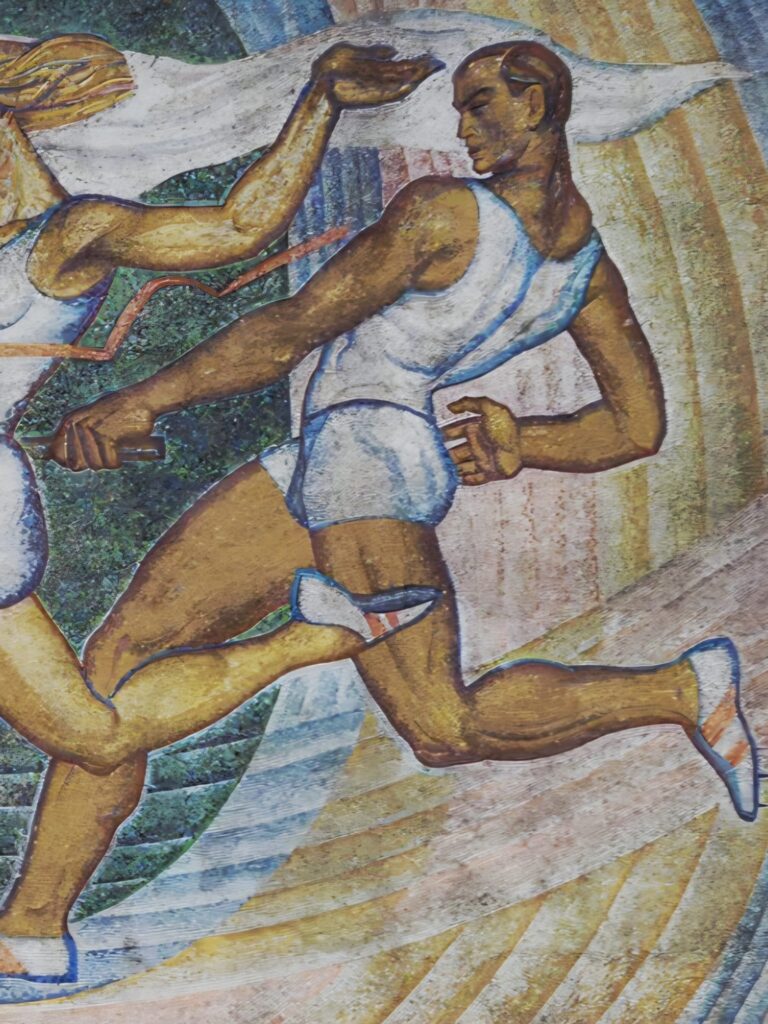
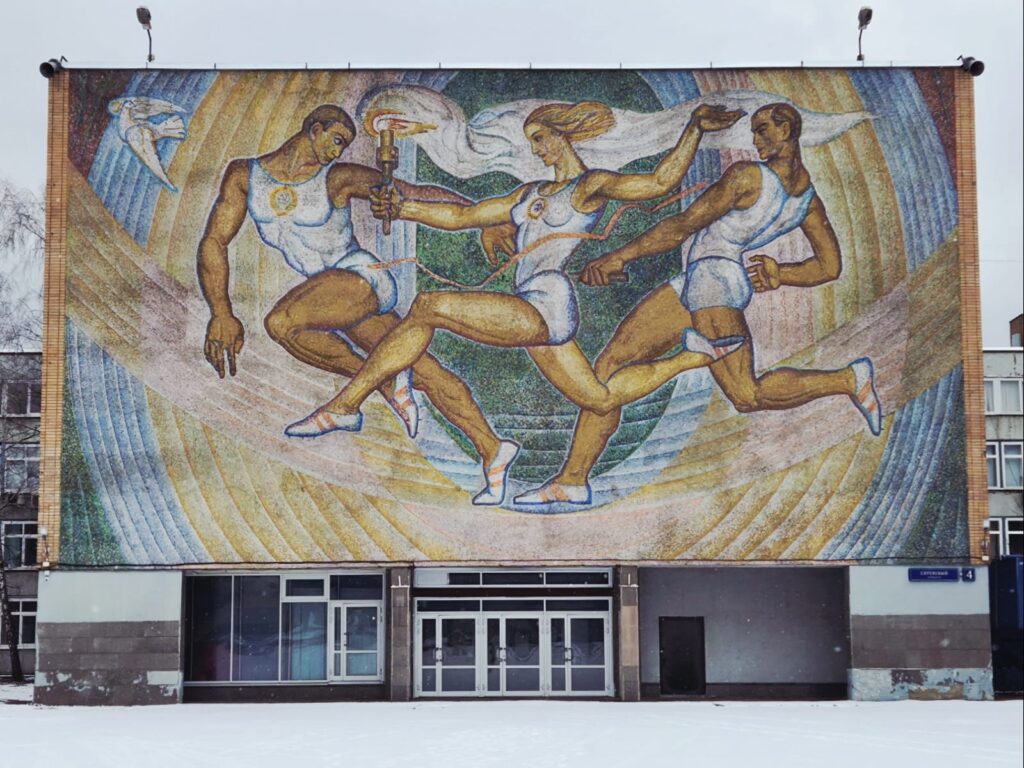
The ‘Relay’ mosaic by Klavdia Tutevol is one such example, a product of this broader propaganda machine. Yet today, removed from its original context, it invites a different question.
Public Art in Soviet Cities: More Than Decoration
As sports were heavily promoted across the Soviet Union, stadiums, gymnasiums, and even schools became central to this effort. Children were required to complete the GTO (Ready for Labour and Defence) fitness tests, reinforcing physical strength as a civic duty.
Many of these institutions were decorated with mosaics depicting athletic scenes, celebrating sport as both a cultural ideal and a tool of state propaganda.
Mosaics across the Soviet Union consistently depicted athletes as physically ideal, muscular, upright, and confident. Works such as Worker and Kolkhoz Woman by Pavel Korin reflect a broader visual language in which strength, movement, and unity embodied the socialist ideal.
Visualising Strength and Unity in Soviet Sports Propaganda
Soviet monumental art was deliberately placed in everyday public spaces so people encountered idealised athletic bodies as part of their everyday lives. This constant, everyday exposure subtly reinforced the idea that strength and physical fitness were normal traits of every citizen.
Over time, athleticism came to feel less like a personal choice and more like an everyday social standard people were encouraged to meet.
Behind the ‘Relay’ Mosaic: Who Was Klavdia Tutevol?
Klavdia Tutevol (1917 – 1980) was a Soviet-era artist trained under prominent figures such as Aristarkh Lentulov and Alexander Deyneka. She worked within the system of monumental and decorative art, collaborating with architects to create large-scale public works, including the ‘Relay’ mosaic.
The ‘Relay’ mosaic was completed in 1973 and depicts powerful, dynamic athletes set against a semi-abstract background, with a green oval stadium at its centre. A female athlete carries a torch with a white dove positioned ahead of the group, reinforcing themes of movement, unity, and progress.
Tutevol was part of a generation of artists who shaped the visual identity of Soviet cities, using sport as a central motif to communicate ideals of strength, discipline, and collective achievement.
Are Soviet Sports Propaganda Mosaic Still Relevant Today?
The ‘Relay’ mosaic remains relevant today, though its meaning has shifted. Instead of promoting state-driven athletic ideals, it is now often seen as a historical and cultural artefact. These mosaics are appreciated for their artistic style, craftsmanship, and for what they reveal about how the state once used visual culture to shape behaviour.
Soviet sports mosaics are valued for their artistic style and craftsmanship, as well as for what they reveal about how sport was used to shape behaviour and project ideals of strength and discipline.
Interpretations depends, some see them as symbols of a system that imposed strict athletic standards, others view them with nostalgia or as sporting heritage, while many pass them in everyday life without noticing their original sports meaning.
The ‘Relay’ mosaic can be found at the Russian State University of Physical Education, Sport, Youth and Tourism (SCOLIPE).
Discover Soviet Sport Propaganda Mosaics
Our project has mapped quite a few monumental artworks depicting space exploration across the former USSR. Using our Interactive Map, you’ll be able to find them, view them, and navigate to them easily!
If you’d rather join a guided adventure, several guides or tour operators, such as by Ravi Mistry, the author of this blog post, offers unique opportunities to explore former Soviet regions with experts who know their history and hidden corners.
Leave a Reply