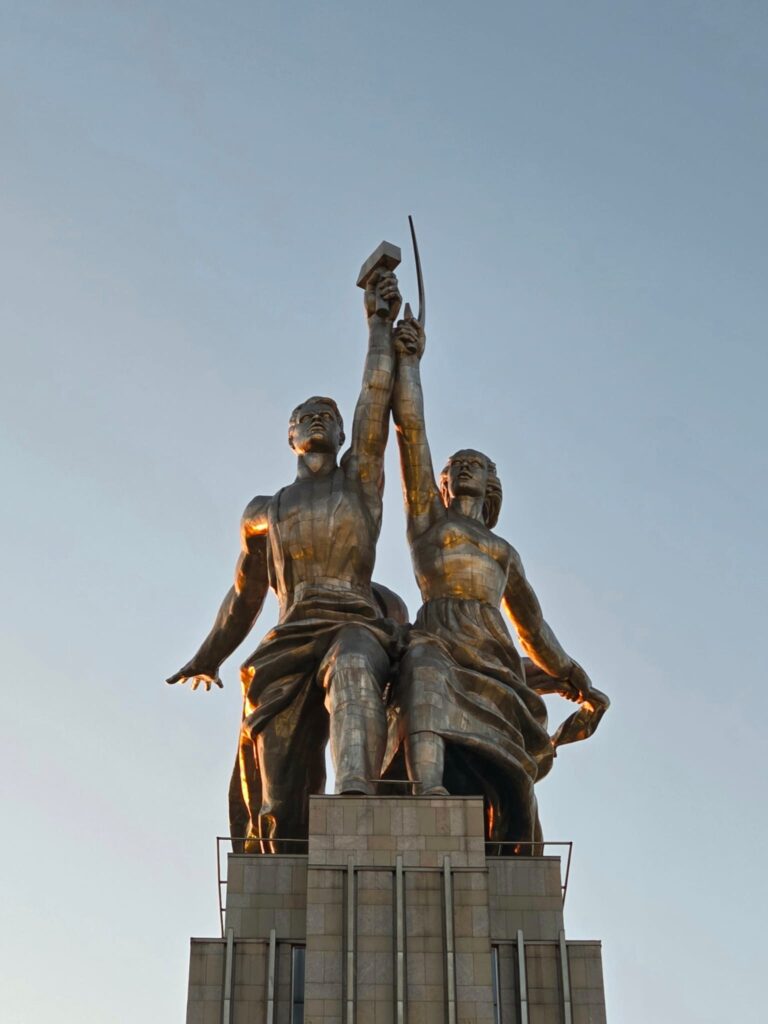
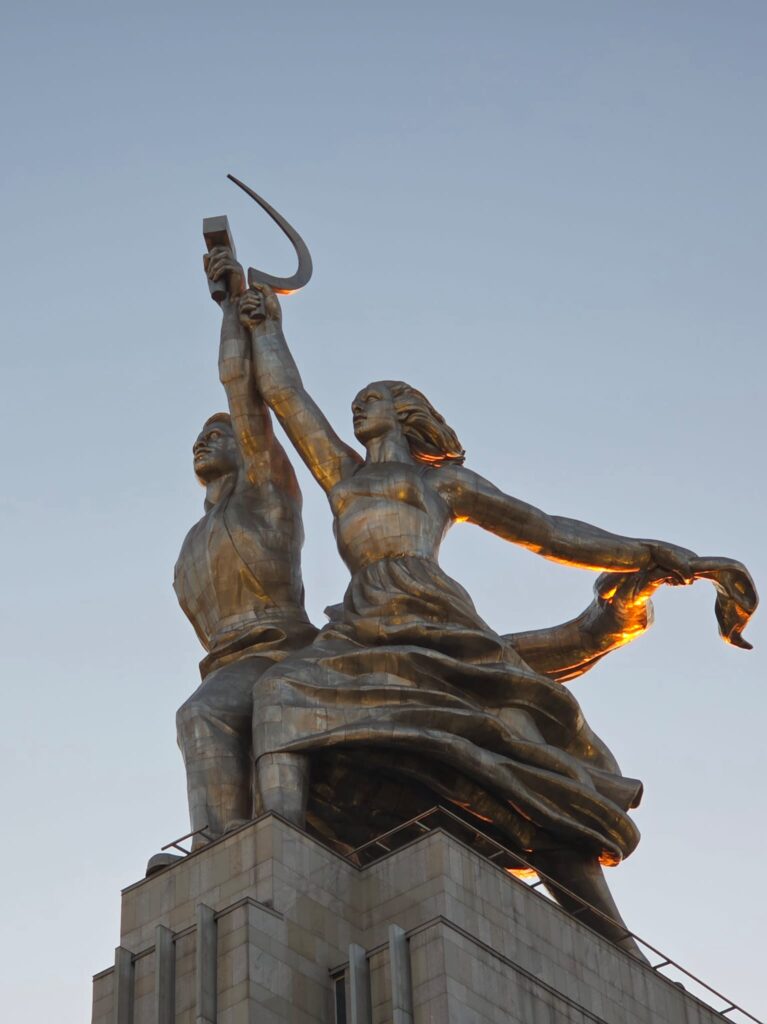
The “Worker and the Kolkhoz Woman” is one of Russia’s most iconic symbols of the Soviet era. Created in 1937 by sculptor Vera Mukhina, it depicts a male factory worker and a female collective farm worker raising the hammer and sickle together – symbolizing unity between industry and agriculture.
However, unknown to many, beneath Moscow lies another artistic masterpiece that echoes this same symbolic power: Pavel Korin’s interpretation of the “Worker and the Kolkhoz Woman”.
Worker and the Kolkhoz Woman Sculpture
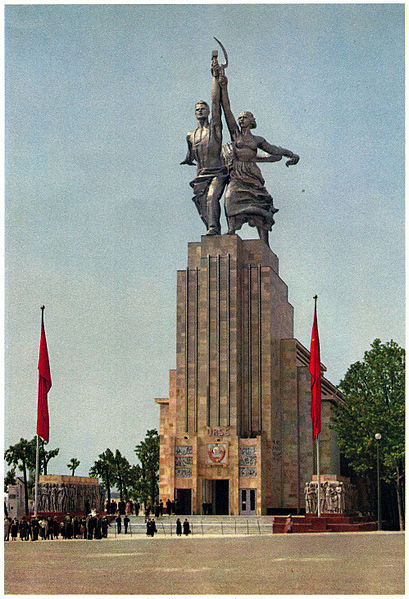
The Worker and Kolkhoz Woman (Рабочий и колхозница) sculpture depicts two figures raising a hammer and sickle above their heads. Its concept and composition were designed by architect Boris Iofan, and it was brought to life in stainless steel by sculptor Vera Mukhina. Standing 24.5 metres (78 feet) tall, it was created for the 1937 Paris International Exposition, where it crowned the Soviet pavilion before being relocated to Moscow.
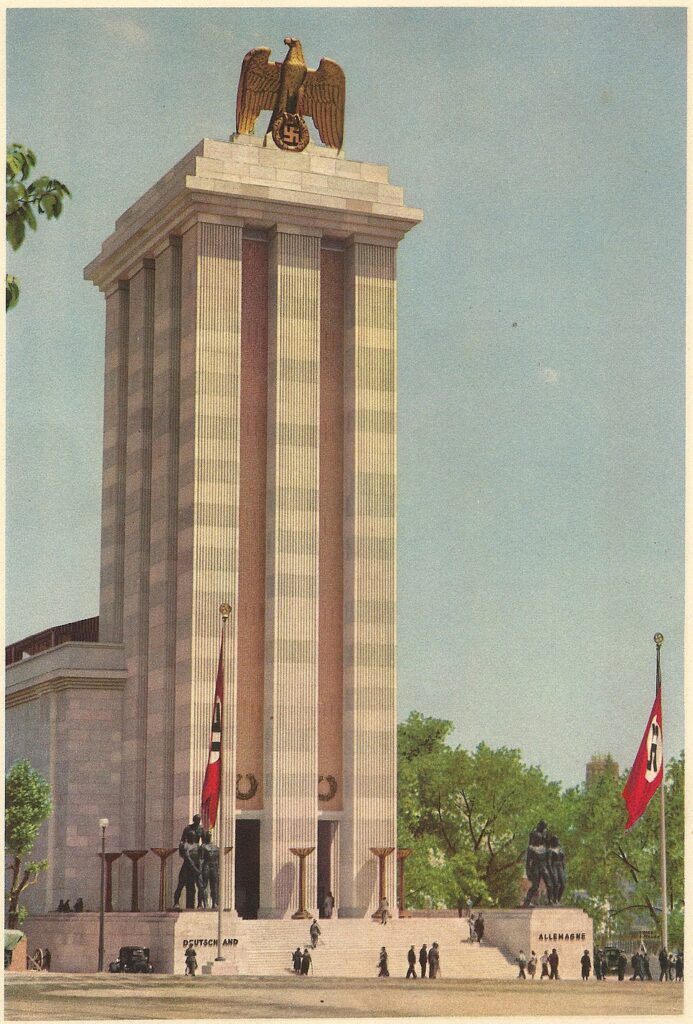
The organisers famously positioned the Soviet and Nazi German pavilions opposite each other, turning the display into a striking symbol of ideological rivalry. While there is little evidence to confirm whether Korin was directly influenced by Mukhina’s sculpture, it is more likely that both artists were shaped by the same political and artistic environment of their time.
The artwork at Paveletskaya Metro Station
Paveletskaya (Павеле́цкая) Metro Station is a station on both the Koltsevaya (5/Brown) and Zamoskvoretskaya (2/Green) lines of the Moscow Metro. Opened on 1st January 1950 as part of the system’s fourth construction phase, it was designed by architects Nikolai Kolli and I. Kastel in the grand Stalinist style of the late 1940s–early 1950s.
The station’s design draws inspiration from the nearby Paveletsky railway terminal, which connects Moscow to the Volga region. This influence is reflected in its agricultural themes and rich materials: square columns clad in white Koyelga marble are accented with red marble bands, alongside elegant marble pillars topped with modern Ionic capitals.
Bright bronze chandeliers illuminate the space, while the walls continue the two-tone marble scheme, white above and red below. The floor is finished with a refined pattern of grey and white granite, completing the station’s monumental and harmonious interior.
The Worker and the Kolkhoz Woman
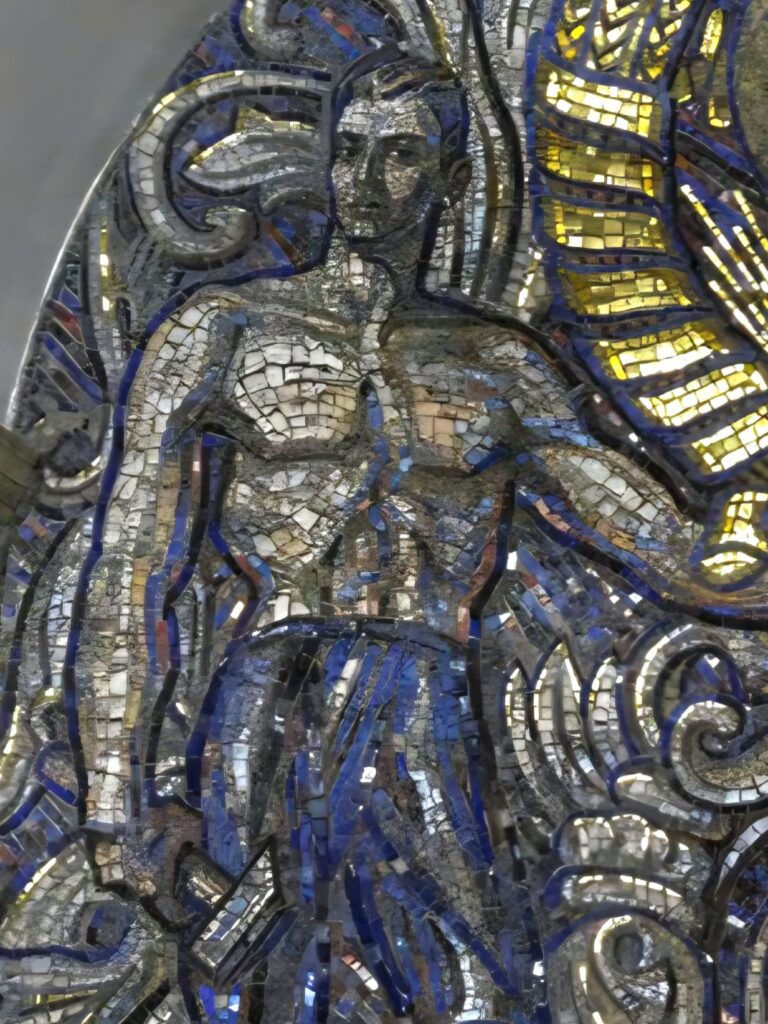
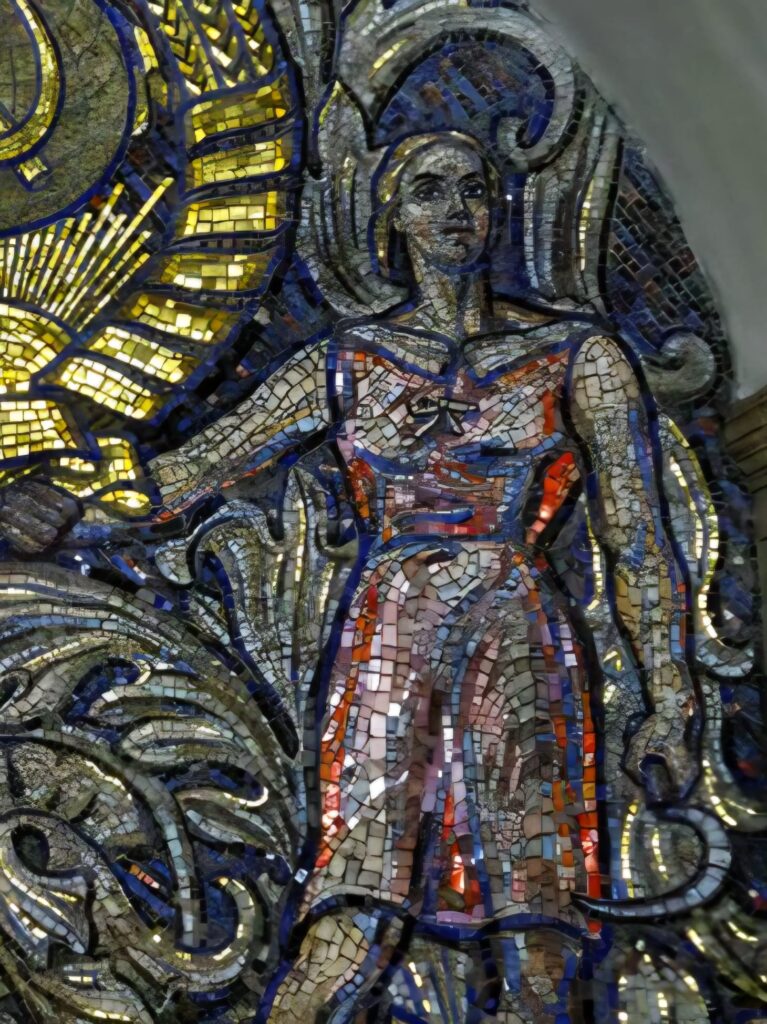
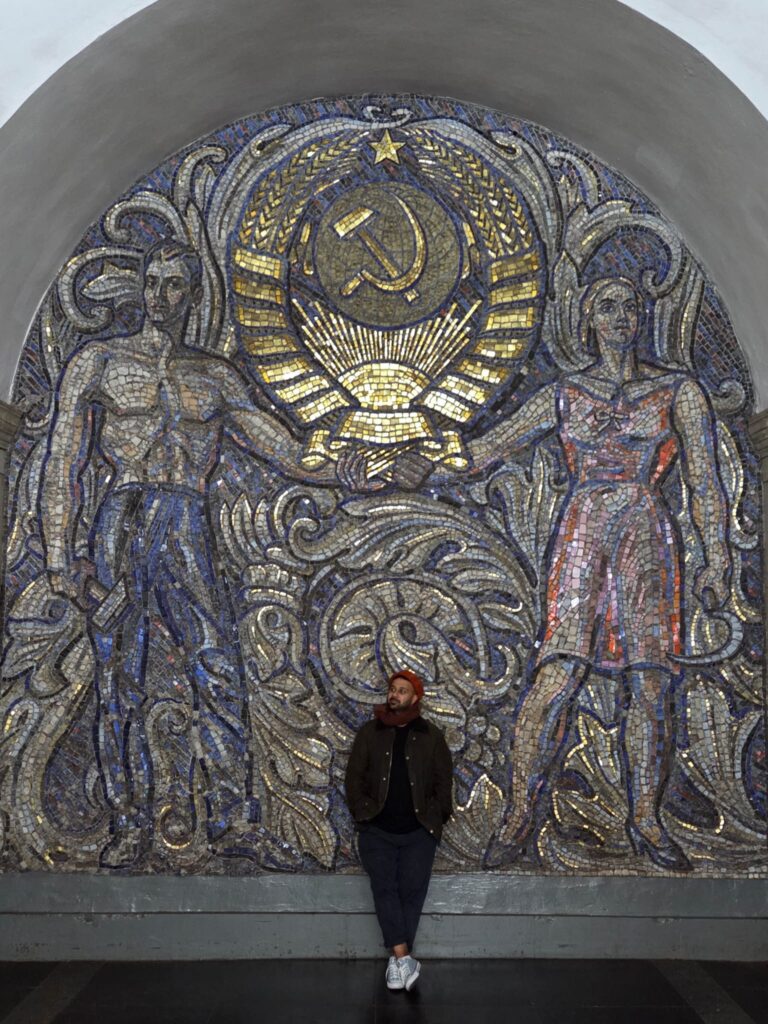
Originally, the end of the station featured a large medallion depicting Vladimir Lenin and Joseph Stalin, created by sculptor Matvey Manizer. During the period of De-Stalinization, this was replaced in 1963 by a new artwork designed by Korin, reflecting the enduring Soviet theme of unity between the working class and the peasantry.
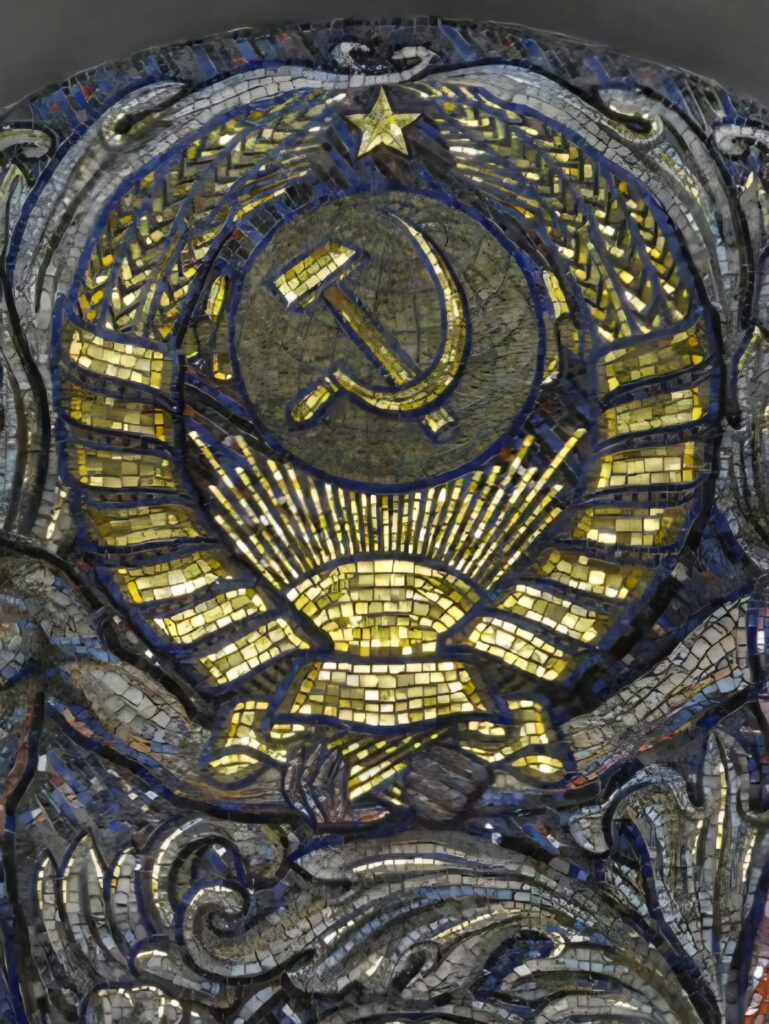
Intricate and complex in design, yet simple in meaning, the composition expresses unity. A bare-chested, physically strong worker grips a hammer in his right hand, while his left clasps that of a peasant woman. She stands in a striking short summer dress and high heels, holding a sickle—together embodying the union of labour and agriculture.
The figures stand united, holding the crest of the Soviet Union against a backdrop of rich vegetation reminiscent of a Florentine Renaissance cathedral. The depth of materials and richness of the colours used are striking in person, something photographs simply fail to capture.
The Worker and the Kolkhoz Woman also marks a tribute to Korin’s final monumental work in the Moscow Metro.
Who was Pavel Korin?
Pavel Dmitriyevich Korin (Павел Дмитриевич Корин) was born in 8th July 1892 into a family of professional icon painters—his father, Dmitry Nikolayevich Korin, being a respected master of the craft.
Korin apprenticed under Mikhail Nesterov, working on frescoes at the Intercession Church in the Convent of Martha and Mary. Nesterov later urged him to pursue formal training, securing his place at the Moscow School of Painting, Sculpture and Architecture.
Among Korin’s most iconic works is the portrait of Georgy Zhukov, begun in Moscow and later continued in Berlin in 1945 due to Zhukov’s military commitments there.
In the 1950s, Korin created a series of monumental mosaics for the Moscow Metro, including works at Komsomolskaya, Smolenskaya, and Novoslobodskaya, the latter famed for its striking stained-glass panels and the mosaic “Peace to the World.”
Korin died in Moscow on 22nd November 1967, and was laid to rest at Novodevichy Cemetery. In accordance with his wishes, his studio—along with its invaluable collection—was preserved as part of the Tretyakov Gallery, ensuring his artistic legacy endures.
Discover Moscow Metro Mosaics
Our project has mapped quite a few monumental artworks depicting space exploration across the former USSR. Using our Interactive Map, you’ll be able to find them, view them, and navigate to them easily!
If you’d rather join a guided adventure, several guides or tour operators, such as by Ravi Mistry, the author of this blog post, offers unique opportunities to explore former Soviet regions with experts who know their history and hidden corners.
Leave a Reply