Originally published in Russian by the Soviet Mosaic Fund, this text has been translated and carefully adapted by The Atlas Sovieticus for English-speaking readers, with the aim of expanding international access to the history of Soviet monumental art. Please vist SMF here, and find the original article here: Исцеление человека — советская мозаика | Каталог Фонда Советской Мозаики. The article was written with the consulting assistance of Taisiya Sakharova.
In the 1970s — a period now commonly referred to as the era of Soviet Modernism — monumental art experienced a remarkable rise. Seeking to move away from the pomp of the Stalinist Empire and to develop a new visual language for rapidly expanding residential districts, artists and architects turned toward a synthesis of the arts.
It was during this time, in northwestern Moscow, that a work destined to become one of the largest, boldest, and most philosophically profound achievements in the history of Soviet monumentalism was born.

The mosaic panel Healing of Man, created by the artistic duo of Leonid Polishchuk and Svetlana Shcherbinina, is located on the façade of the library of the 2nd Moscow State Medical Institute (today the Pirogov Russian National Research Medical University). Covering a surface of around two thousand square meters, it is one of the largest monumental mosaics in Europe. Yet the uniqueness of the work lies not only in its scale. Healing of Man is a total artistic statement — a philosophical monumental poem dedicated to eternal themes: birth and death, suffering and compassion, scientific progress and moral responsibility.
– Artworks combined: 8 compositions
– Size: 2,000+ square meters of mosaic
– Theme: Love for humanity and faith in healing / Knowledge becomes a force capable of healing

Work on the panel began at the invitation of architect Vladimir Fursov, the designer of the entire university complex. The library building itself was a typical example of modernist architecture — a strict, laconic cube measuring 44 meters on each side. Such architecture, stripped of decoration, posed a challenge for monumental artists.
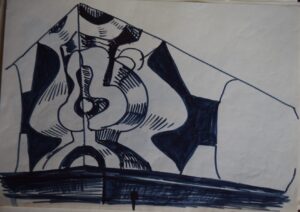
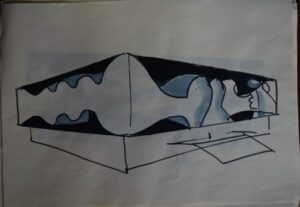
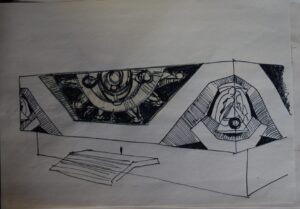
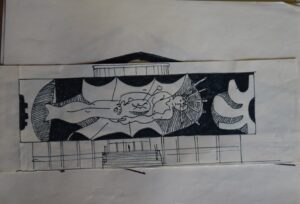
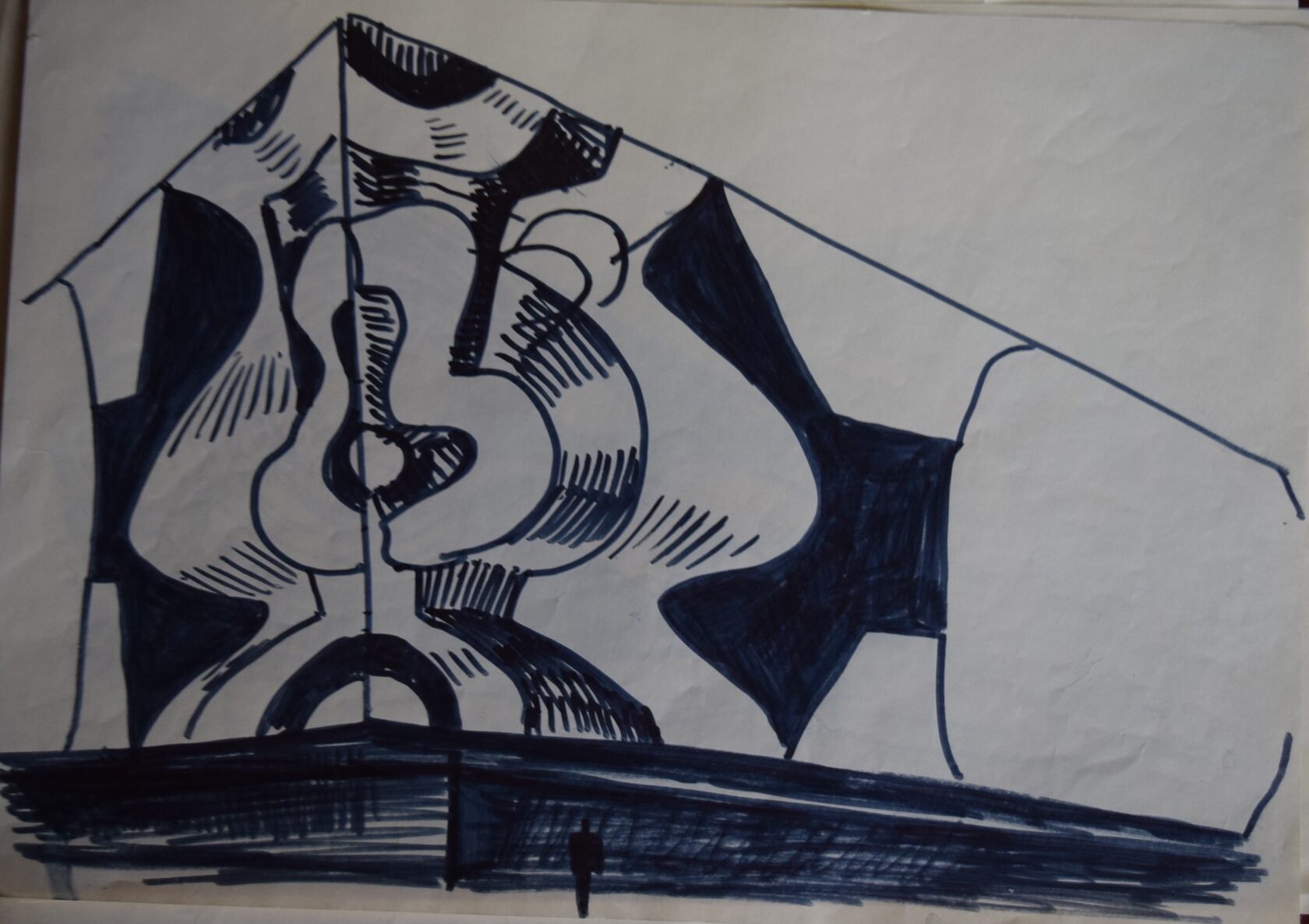
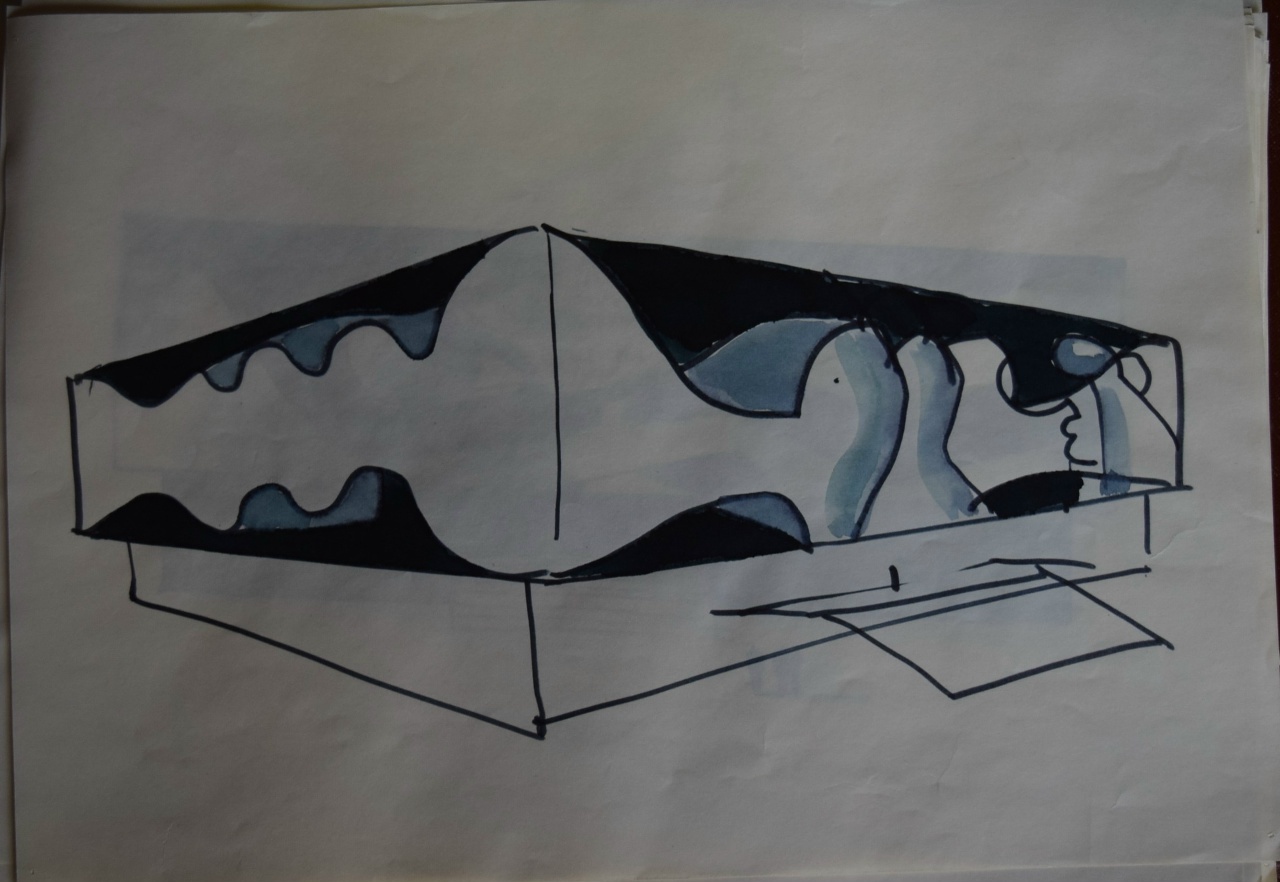
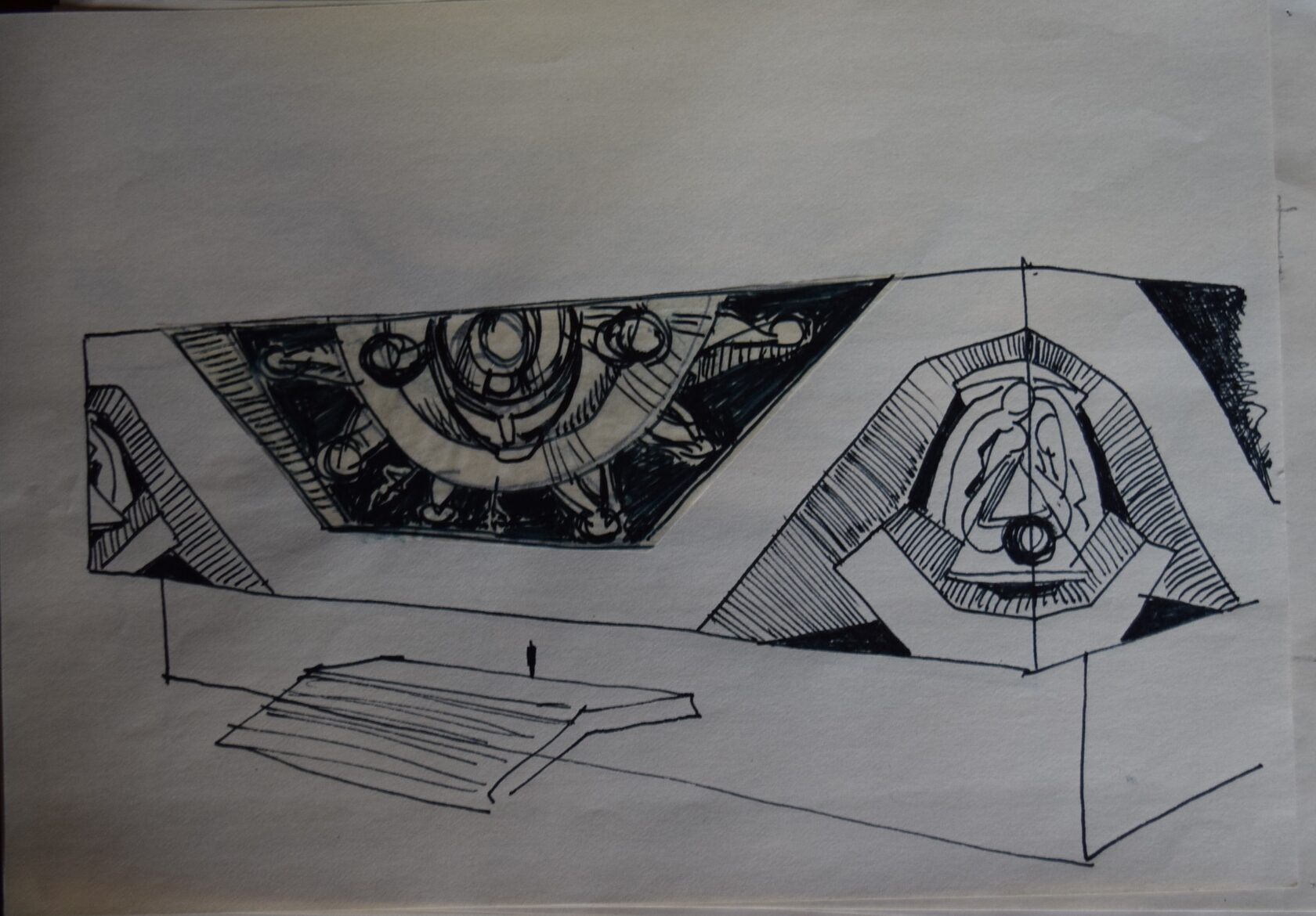
Polishchuk and Shcherbinina proposed a solution that contemporary critics would later call revolutionary. Rather than limiting compositions to the flat surfaces of the façade, they shifted the visual center of gravity to the building’s corners. Four of the eight scenes — Birth, Salvation, Healing, and Hope — were placed across the junctions of the walls.
This concept required a major rethinking of the architecture itself. Fursov, recognizing the scale of the artists’ vision, took the unprecedented step of sealing all the second-floor windows that would have disrupted the integrity of the mosaic surface. He leveled the wall, transforming the façade into an ideal plane for monumental imagery. The architect did not merely approve the artists’ proposal — he redesigned the building around their vision, demonstrating an understanding that a true synthesis of the arts demands compromise from both sides.

A Synthesis of Architecture and Monumental Painting
This fusion of architecture and monumental painting created a double effect:
Plastic / Spatial Effect
The mosaic ceased to function as a mere “picture on a wall.” It wrapped itself around the building, emphasizing its geometry while simultaneously overcoming it. The large-scale forms and internal energy of the images visually transformed the perception of the library building, turning a standard modernist block into an ideological and emotional center.
Semantic Effect
A composition “breaking” across a ninety-degree angle creates in the viewer a sense of physical discomfort and tension. This daring device was entirely intentional. Each scene evokes strain or emotional fracture, much like the human body laid upon an operating table.
In this way, the artists achieved the very synthesis of the arts that modernist theorists had dreamed of: architecture and painting ceased to exist separately and merged into a single artistic organism.
The Artists
Leonid Polishchuk and Svetlana Shcherbinina — spouses and creative partners — built careers marked both by major artistic achievements and by dramatic conflicts with Soviet authorities. The emotional intensity and symbolism of their works repeatedly caused ideological disputes. Several of their projects were destroyed for political reasons, making the survival of Healing of Man all the more significant.
Polishchuk’s experience as a veteran of the Second World War and participant in the 1945 Victory Parade undoubtedly left a deep imprint on his work, shaping the seriousness and tragic intensity with which he approached the depiction of the human condition.
Their artistic language reveals the influence of Mexican muralists such as Siqueiros and Rivera, with their social pathos and focus on ordinary people. Yet the Soviet artists transformed these influences into something entirely their own. Their works gravitate toward symbolism and magical realism. They do not simply illustrate reality — they expose its deeper, often troubling layers.


The Symbolic Cycle
The mosaic cycle Healing of Man consists of eight scenes divided into two groups: four corner compositions and four façade compositions. Together they form a unified narrative about humanity’s journey through suffering toward healing — both physical and spiritual.
Corner Compositions
These scenes are based on real medical cases, giving the monumental imagery a deeply personal and human tone. The artists employed an unusual spatial device: patients are often depicted upside down, forcing the viewer into the perspective of the sufferer and intensifying empathy.

“Birth”
The cycle opens with the appearance of new life. At the center is an operating table where a woman who has just become a mother stretches her arms toward her newborn child, gently held by one of the obstetricians. Two other doctors stand nearby.
On either side are two additional women in labor. Unlike the central figure, one of them is not destined for survival; her pose hints at the tragic outcome of childbirth. The juxtaposition of these images creates emotional tension and visualizes the panel’s central leitmotif — the inseparable bond between life and death, and the fragility of human existence at its most important moment.


“Hope”
In this composition, human figures yield dominance to the technological world. There are no doctors here — only a patient undergoing examination inside a tomograph and the exaggerated image of a medical machine.
Yet the machine becomes more than mere technology. It resembles a keyhole into which the human being — the key — is inserted. The artists suggest that modern humanism is impossible without technology. Here, it appears as a salvific instrument of diagnosis and knowledge, restoring hope for recovery.


“Salvation”
The emotional intensity rises. The operating scene is permeated with inner tension: surgeons are locked in battle with death itself. Their faces are concentrated, every movement precise.
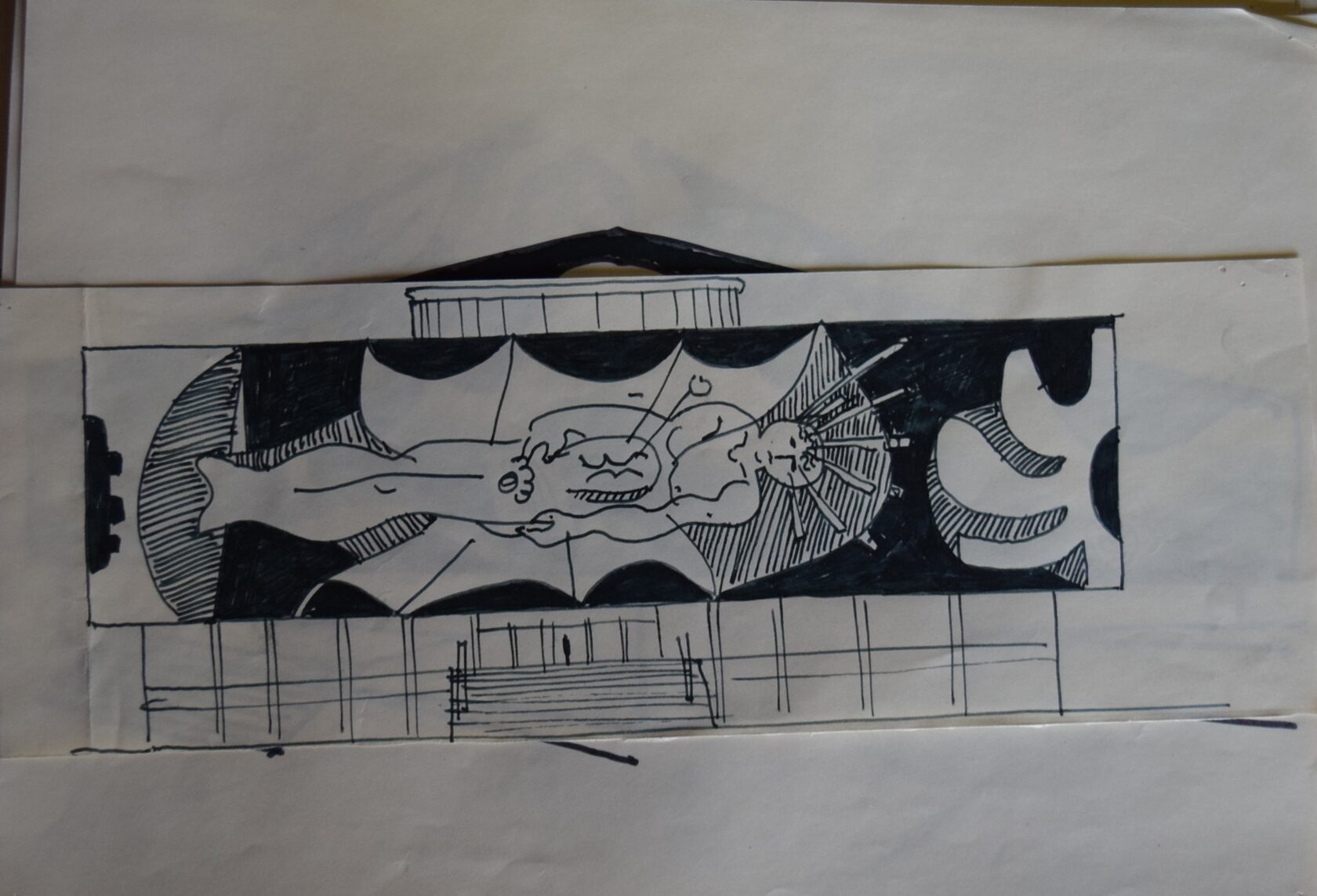
At the center lies the patient, seemingly detached from reality. Once again, the figure is depicted upside down, emphasizing the fragility of life. On the left is a table of surgical instruments; on the right, an assistant carefully watches the monitors. Beneath the light of the operating lamp suspended above the doctors, the miracle of returning to life takes place.


“Healing”
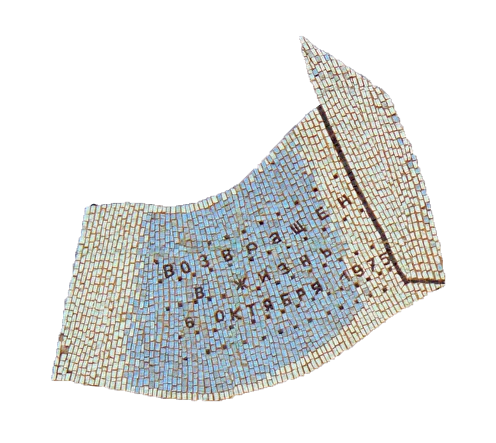
The central scene — which gives the entire cycle its title — refers to a real event: the moment when a patient opens his eyes after an extremely difficult operation.
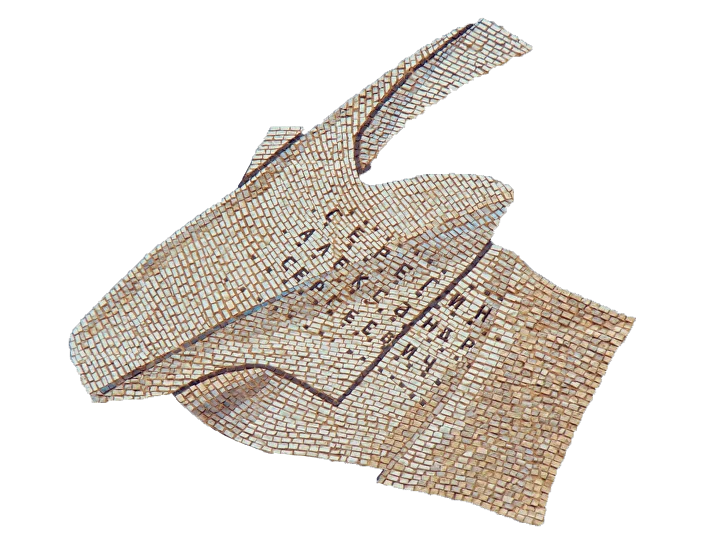
In his memoirs, Polishchuk revealed the prototype behind the scene: the rescue of a construction worker who fell from scaffolding, was “shattered to pieces,” and then “reassembled” in intensive care at the Sklifosovsky Institute.
The artists deliberately preserved this connection to reality through details. Both on the mosaic itself and in the sketches, one can discern inscriptions bearing the name “Alexander Sergeyevich Seregin” and the sacred phrase “Return to life — November 10…”
The genius of the composition lies in its depiction of a liminal state — a second birth, an emergence from nonexistence. In the patient’s face are frozen pain, astonishment, and the first glimmer of returning consciousness.


Façade Compositions
These four scenes occupy the flat wall surfaces and carry equally profound symbolic meaning:
“Discovery of the Genetic Code”
In the foreground are chromosomes, representing the invisible sphere of the human organism that determines both birth and the course of life itself.
One of the key scientific discoveries of the twentieth century receives an unexpected iconographic interpretation. Three figures inscribed within one another evoke the iconography of the Holy Trinity. The structure of the image — the interweaving and hierarchical unity of the figures — reveals the mystery of a triune being.
Polishchuk and Shcherbinina transpose this sacred model into the realm of scientific knowledge. Just as the Trinity expresses a single divine essence through three hypostases, the composition presents a triune structure: the bearer of the genetic code, the code itself, and the mystery of heredity linking generations.


The comparison between genetics and Trinitarian imagery points toward the sacred dimension of science — a science that seeks to comprehend the hidden foundations of existence.
“Awaiting Healing” (“The Sufferer”)
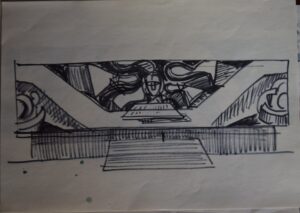
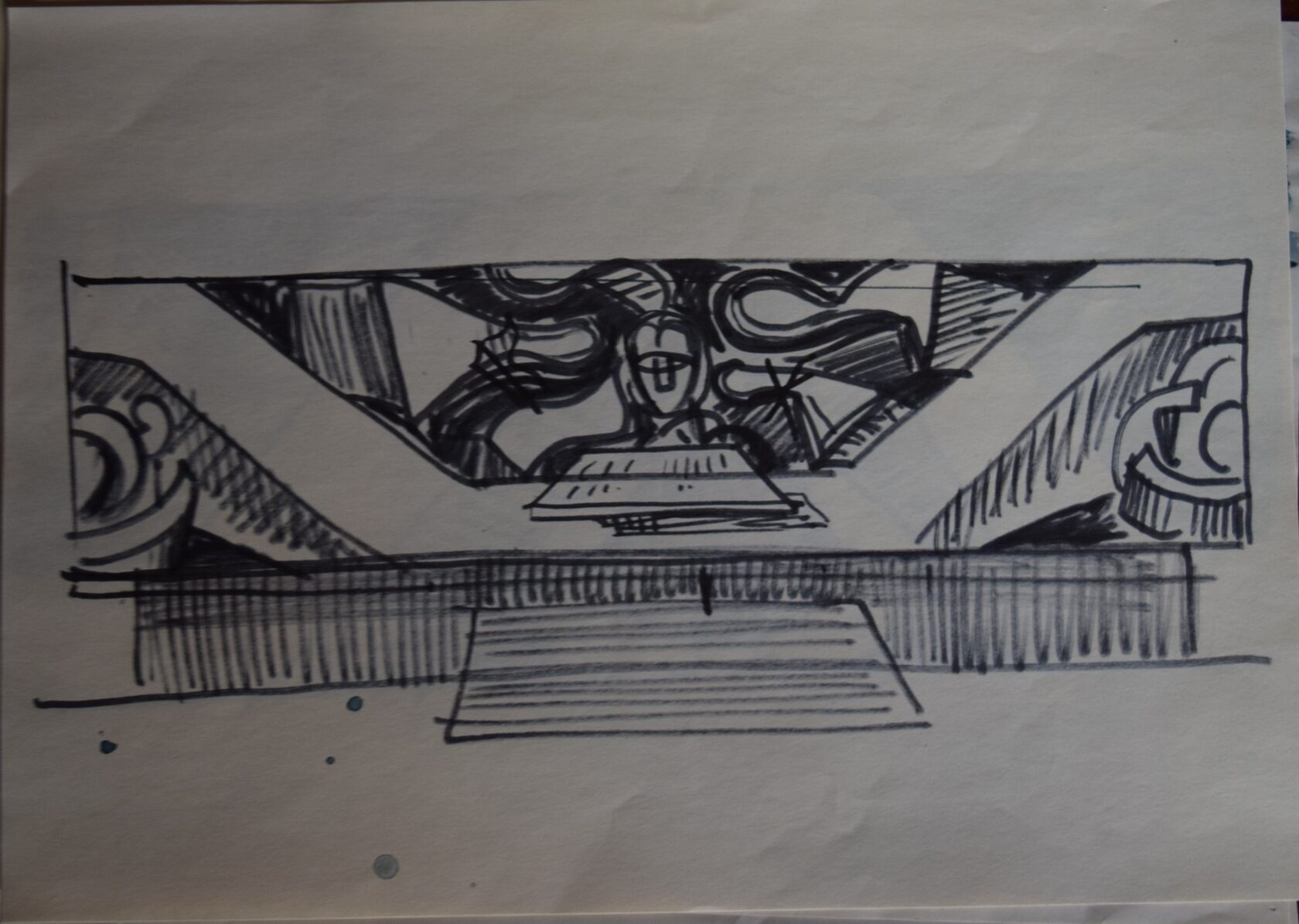
This may be called the emotional epicenter of the entire mosaic. From the surface of the wall emerges an enormous face distorted by suffering. In this image appears the archetype of “Christ Crowned with Thorns,” embodying the pain of all humanity.
The effect of presence is overwhelming. The artists constructed the image so that its gaze seems to follow the viewer wherever they move. Polishchuk himself emphasized this intention:
“The head of the Sufferer turns to you for help. Only to you — because wherever you go, its gaze will pursue you everywhere.”
The viewer is left alone with the suffering of the world.


“Life Is in Your Hands”
Here again Christian symbolism and dramatic intensity emerge. The central human figure is composed almost like a crucifixion. His hands are not merely extended — they are literally placed into the hands of the doctors. The heart, the seat of life, also rests in the healer’s palms.
Another important detail is the pair of eyes in the background. They seem to reassure the viewer: no human being is alone; someone is always watching over them.


“Books and the Tablet”
Located above the library’s main entrance, this composition simultaneously reflects the building’s purpose and acts as a moral testament. The artists depict a surreal scene in which open books float like birds through the air while words fly directly toward the viewer: “Mind,” “Honor,” “Conscience,” “Kindness,” “Knowledge.”
In the context of the entire mosaic cycle — already filled with references to the Trinity, Crucifixion, and Christ — this composition reads as the culmination of a sacred theme. It resembles a secular Bible, where instead of abstract dogma there are direct commandments addressed to physicians.
The artists seem to warn us: only knowledge framed by honor and warmed by kindness can become a force capable of healing.
From Birth to Healing
Of course, the cycle is not a literal illustration of the New Testament. Rather, it translates its structure into the language of medicine and humanism.
Christ passes through birth, suffering, and resurrection. So too does every patient to whom medicine grants another chance at life. In this sense, the mosaic becomes a monumental reminder that medicine rests upon the same principles as Christianity: compassion, love for humanity, and faith in healing.
This raises an important question: why did the artists choose such a complex symbolic language?
The answer lies in the historical and cultural context of Soviet society. A direct appeal to religious symbolism in monumental art intended for thousands of students and professors was either impossible or required complicated negotiations with ideological authorities.
Polishchuk and Shcherbinina found a brilliant solution: they created a system of crypto-Christian symbols. Religion is not openly declared; instead, it is concealed within a humanistic discourse about medicine. Yet it is precisely this hidden religious framework that gives the imagery its true depth.
The result is a coded system of messages in which Christian imagery functions as a cultural matrix, granting scientific subjects a timeless dimension.

Thus, the “hidden” religion of Healing of Man became a deliberate artistic strategy that allowed art, even during the dominance of atheistic ideology, to reclaim its ancient role as a bridge between the earthly and the divine, between individual suffering and the eternal questions of existence.
Artistic Method
The key to understanding the compositional structure of the mosaic lies in the artists’ unique relationship to architectural space.
Polishchuk recalled that ever since Byzantium, the architectural corner had been regarded as the most vulnerable point in a structure — the place where walls meet and separate. Polishchuk radically overturned this idea. The corner would no longer be a passive meeting point of surfaces; it would become the main protagonist.
The upside-down figures of patients are literally “broken” by the intersection of the walls. Pain cuts through the human body. The artist himself described the concept succinctly:

“Man is crucified by pain. Pain ‘breaks’ a person — therefore the person is broken by the CORNER.”
Analyzing the stylistic language of Healing of Man, one can conclude that the work anticipated many artistic developments that would become central to twenty-first-century art. It fits neither within the doctrinal limits of Socialist Realism nor within the postmodern irony that was only beginning to emerge at the time. Instead, it represents a unique synthesis best described as magical realism in monumental art.
In the mosaics of Polishchuk and Shcherbinina, magical realism arises at the intersection of documentary medical reality — surgical instruments, patient postures, operating-room details — and metaphysical symbolism.
The artists depict everyday life in which miracles unfold before the viewer’s eyes.
The Energy of the Line
The expressive, almost poster-like contour animates the entire mosaic cycle.
Polishchuk attached enormous importance to line itself. According to surviving accounts, when recruiting assistants for the mosaic he asked applicants to lay out a single line in smalt. Experienced masters laughed at the simplicity of the task, yet Polishchuk rejected them and continued searching for the precise line he sought.

For him, this was not eccentricity. It reflected a profound conviction: a student can truly learn only by participating in the creation of genuine art.
His ideal was the workshop tradition of the Italian Renaissance, where apprentices observed the master at work and gradually participated in painting sections of a great composition. In every line he saw not merely a technical element but the trace of deeper laws of the universe.
Color Palette
The color scheme follows a symbolic logic. Polishchuk and Shcherbinina deliberately limited the palette in order to achieve a concentrated emotional effect.
- Black — the background against which the action unfolds. It is the abyss separating life from death, an active force emphasizing drama and tension.
- White and silver — the color of doctors’ coats, symbolizing sterility, purity of intention, and professional ethics.
- Blue and light blue — the dominant tones. Their cold palette creates a distancing effect, as though we are viewing the drama through glass.
- Red — blood, suffering, and the pulsating energy of life.
- Gold and ochre — symbols of warmth, human vitality, and divine presence.
The Creation of the Work
The history of this masterpiece began with struggle. For more than a year, Polishchuk and Shcherbinina searched for the one true form capable of embodying their vision. They rejected draft after draft, sensing that the real solution had not yet appeared.
The pressure became so intense that it nearly cost Polishchuk his life. Recalling the darkest moment, he wrote:
“The studio on Bryanskaya Street, ninth floor. All I had to do was take one step… Strangely, even in that mad state, my mind was still searching for the solution to the problem. Because of that I hesitated for twenty or twenty-five seconds. Then Svetlana entered. I could no longer do it in front of her. She led me away from the balcony. Completely emptied, I sank into a chair.”
At that moment, standing on the balcony ready to jump, he conceived the daring idea of breaking the flat surface and allowing the image to wrap entirely around the building.
When the enormous sketches were finally completed, another challenge emerged: would the artistic council approve them?
The council consisted of representatives of the classical academic school, including students of Vladimir Favorsky. What they saw defied all conventional expectations. A long silence filled the room. Finally, the art historian V. Lebedeva spoke:
The council voted in favor of the project.
“This is the mosaic of the century.”
The smalt was produced at three separate glass factories. It was intentionally underfired, giving it a matte texture reminiscent of colored stone rather than glossy glass.
The library officially opened on October 10, 1979.
Professional critics immediately recognized the project as a radical rethinking of architectural space. The mosaic ceased to function as decoration and instead became the conceptual center around which the architecture itself was organized.

From 1973 to 1979, work continued in the workshops of the Monumental and Decorative Arts Combine. First came black-and-white cartoons at one-tenth scale, then dry assembly on tracing paper, and finally the transfer onto concrete slabs destined for the façade.
Fate of the Monument
Yet professional recognition and everyday reality are different things.
For many years, Healing of Man remained hidden in plain sight. Trees planted nearby gradually obscured large portions of the mosaic. What had once been a powerful urban gesture fragmented into isolated visual episodes visible only to occasional passersby.

Everything changed in 1992, when the state granted the work official status as a protected cultural heritage monument. In 2022, a comprehensive scientific restoration project was announced.
“The Consilium of the Great Physicians of the World”
The concept of Healing of Man was never intended to stop at the façade alone.
Inside the university’s main building, Polishchuk and Shcherbinina continued their exploration of medical themes. In 1988 they completed the mural Consilium, occupying a vast second-floor wall.
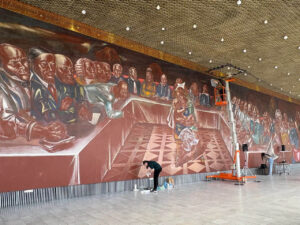
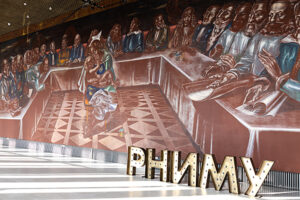
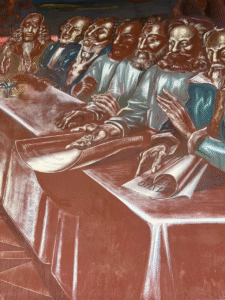
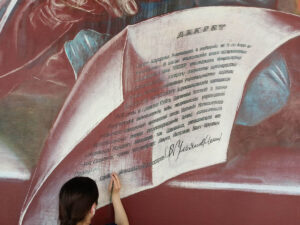
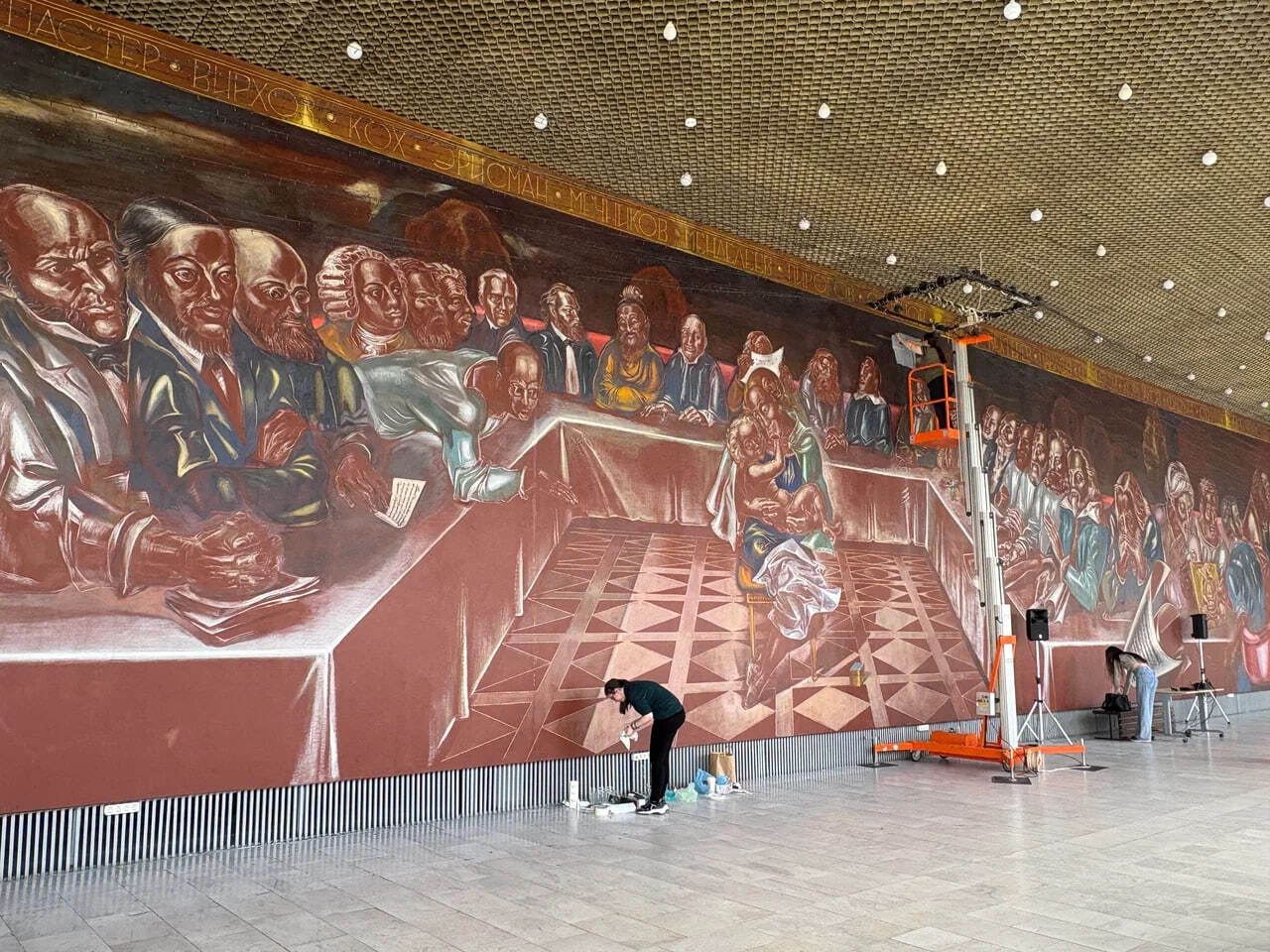
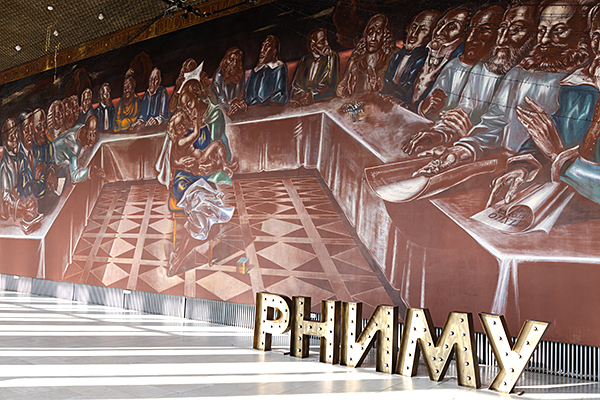
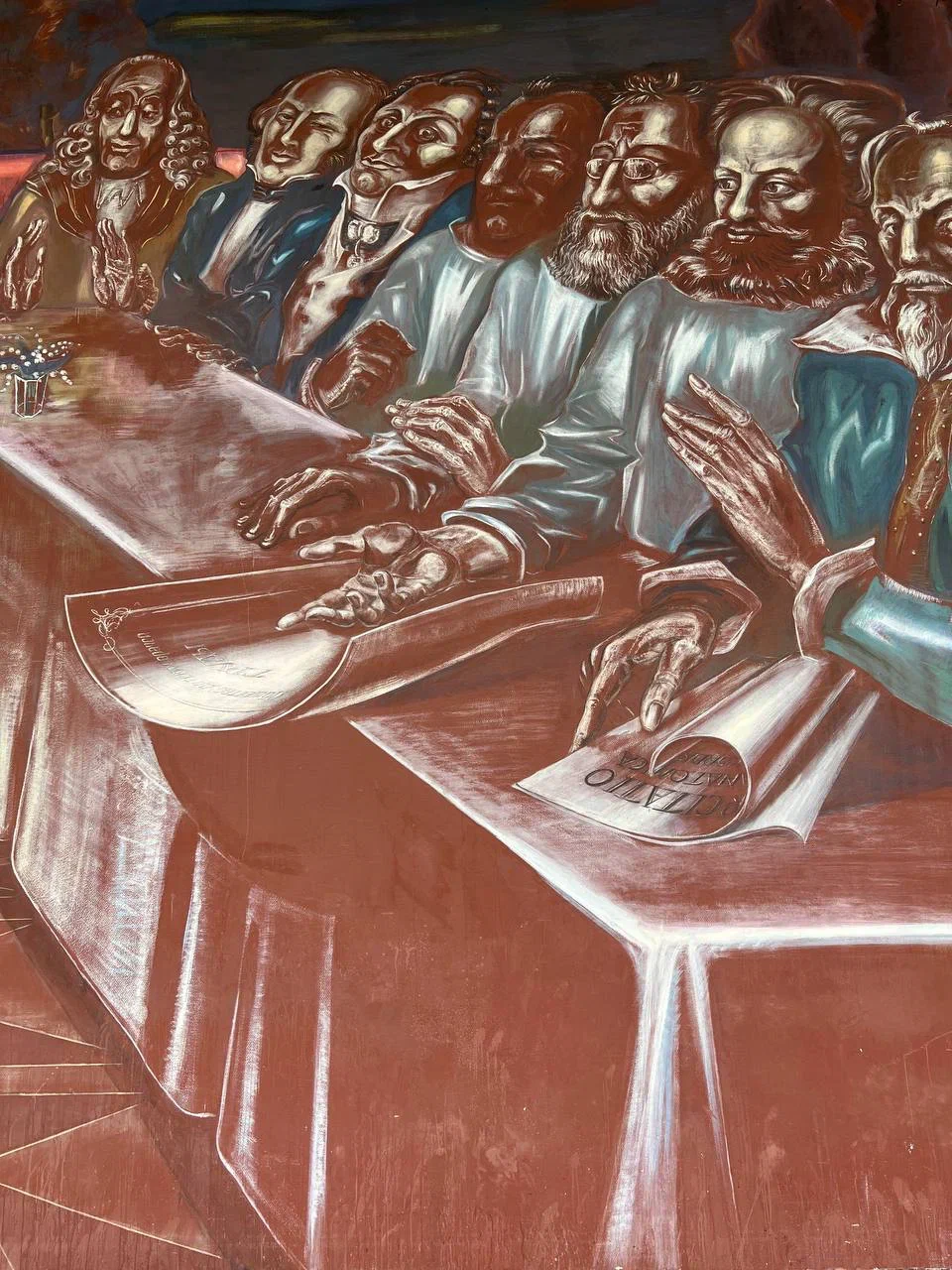
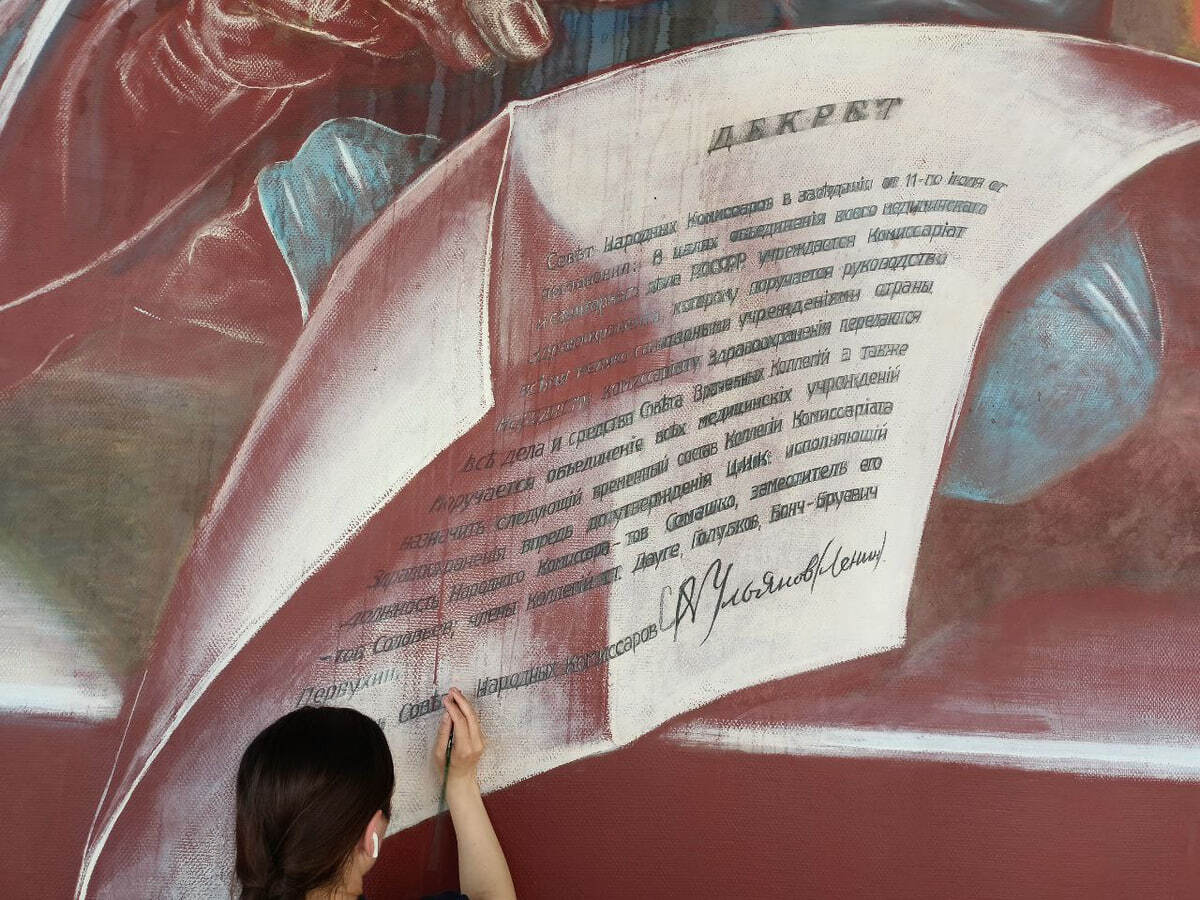
Whereas the exterior used smalt mosaic, the interior mural was executed in tempera, producing a texture reminiscent of icon painting.
Before the viewer unfolds a grand assembly of humanity’s greatest physicians — from Hippocrates to Pirogov — gathered around a Madonna and Child. Yet this is not merely a consultation over a patient. The doctors gaze upon the child as though attempting to pass on all their accumulated wisdom, discoveries, and suffering. The infant becomes a symbol of hope — the future generation that may continue what previous generations began.
Through the glass openings of the building, the exterior mosaic and interior mural literally “see” one another, existing in permanent dialogue.
A third component was originally planned as well: a monumental relief for the rectorate building. Sketches were completed, but the sculpture was never realized. The entire university complex was conceived as a unified ensemble of mosaic, painting, and sculpture.


A Hymn to Life Addressed to Eternity
Healing of Man by Leonid Polishchuk and Svetlana Shcherbinina is a unique phenomenon. Monumental in scale and profound in meaning, it transcended both the era in which it was created and its original purpose as decoration for a medical university.
The artists believed that only eternal themes deserved embodiment in art: birth, motherhood, death, compassion. Their central protagonist was “life itself — contradictory, filled with suffering and heroism.” In this sense, the mosaic on the Pirogov University library enters into dialogue with the great humanists of the past, from Renaissance masters to the Mexican muralists, while remaining deeply original and innovative.
Time has proven that Healing of Man stands among the pinnacles of Soviet monumental art. The words floating across the façade — “Mind, Honor, Conscience, Kindness, Knowledge” — now sound both as an appeal to the present and as a message to the future.
In a world where medicine is becoming increasingly technological and human relationships increasingly devalued, the mosaic reminds us that true healing is possible only through the union of professional mastery and moral integrity.

Article prepared with the consultative assistance of Taisiya Sakharova.
Where to See It
Moscow, Ostrovityanova Street, Building 1, Structure 5
(on the library building of the Pirogov Russian National Research Medical University)
Leave a Reply